This package contains features that require additional payment to a third-party or the package author to access.
Familiar ships zero AI-generated content: all code, UI, and docs are authored, understood, and maintained by the developer. It is AI-integration software. At runtime it connects the user's own AI (BYOK, via MCP or direct provider APIs) to their Foundry world, which generates chat replies, NPC voices, and images live and improvisationally in response to the user's prompt. Nothing AI-generated is pre-bundled or pre-created. Keys travel browser to provider directly across 23 providers: no proxy, no metering, no telemetry, no data collection.
Your AI co-pilot for Foundry VTT
Familiar takes the dungeon master's side of your Foundry table: the rules, the dice, the monsters, every NPC in its own voice. You bought Foundry to run the game for everyone else. Now you finally get to play: solo, one on one, or with a full group.
200+ tools across 27 domains. 30+ AI providers. Bring your own key.
Two weeks free, then $6 a month.
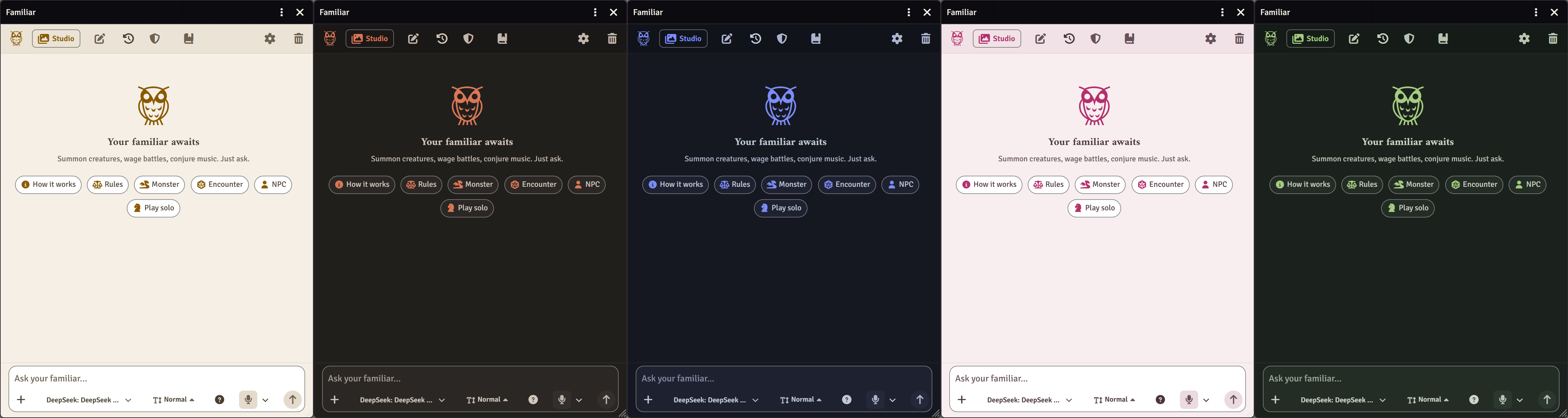
Plays at any table
The fewer humans at the table, the more of the world Familiar runs:
| Solo (just you) | You play your character. Familiar runs everything around it: every NPC, every monster's turn, the scene. It takes an ally's turn beside you too. Play from your own GM login: click Play solo in the chat window, or type /solo Bramble. |
| Duet (you and one other) | Familiar runs the world for both of you: the cast, the encounters, and on D&D 5e (2024) the rulings. You two stay players, in the story, rolling your own dice. |
| Small table (you and a few) | Familiar carries the supporting cast, the monster turns, the lighting, and the music. Nobody drops out of the scene to look up a ruling or cue a track. |
| Full group (you DM for four or more) | You tell the story. On D&D 5e (2024) Familiar handles initiative, the monster turns, and the bookkeeping. |
It runs the DM's side around you; it never invents the story. Whoever is at the table, the campaign you brought is the spine, and on D&D 5e (2024) the dice and the maths are always right. No "you rolled a 47."
Familiar for Players
Every player gets Familiar in their own browser: the Familiar button (the owl), a chat window and the Studio, on their own AI key. It answers their questions, reads their sheet, builds and levels their character, and changes only what Foundry already lets that player change. What the build sets (ability scores, proficiencies, maximum hit points), a level beyond the starting level you set, XP, and coin or items from nowhere wait for you. From Foundry 14.352, and not on The Forge, an image, sound or video clip a player makes without the Upload Files right is saved by your own Foundry tab into a folder of their own while you are in the game. To make their own journals, playlists, tokens, actors, map notes and drawings work, Familiar gives the Player and Trusted Player roles those Foundry rights once per world, and on D&D 5e turns on the system's summoning and transformation switches, with a whispered card and one Take back button. A player can also connect their own AI app. Familiar for Players is on by default; one switch on the Chat tab turns it off.
What Familiar handles
Type "the goblins ambush the party from the treeline" and Familiar rolls initiative, drops the goblin tokens into cover, dims the lights, cues the forest ambience, and gives each goblin its own voice.
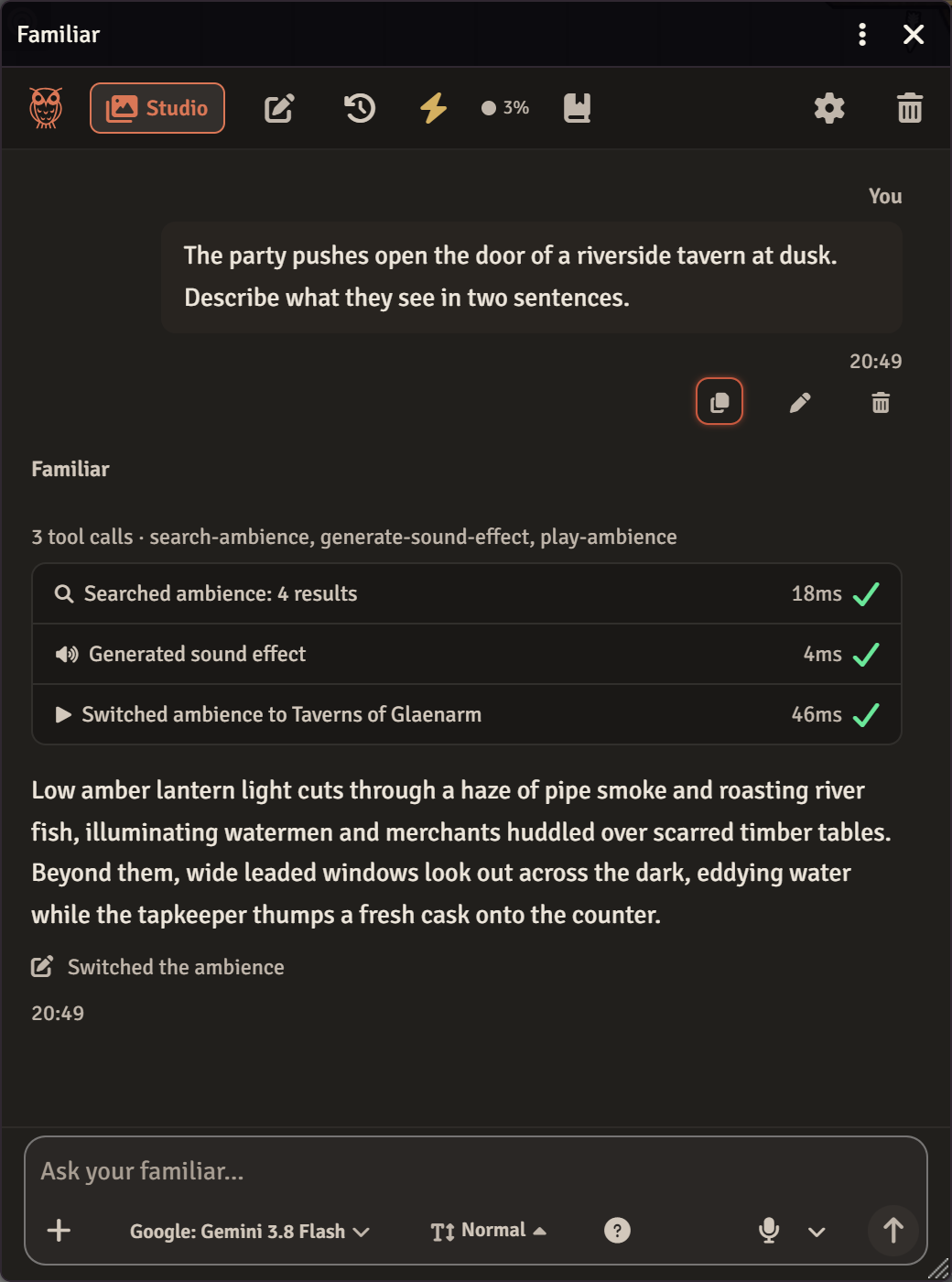
- It runs the published adventure you imported and plays its cast in character and in voice. A spoken line can wait for your go, and every line lands in the chat under the speaker's name.
- Ask for a scene and it builds one: tokens placed, walls and doors drawn, lighting, darkness, and weather set.
- Portraits, item art, and battle-map backgrounds come out of the chat. On OpenAI, fal.ai, or OpenRouter it edits an image it made; on fal.ai it animates a still into a looping clip and lays it over the scene as a moving map. Familiar Studio keeps every image, clip, and track it made in one window and fills empty portraits in one run.
- Name a mood and it finds one in your own playlists, crossfades to it, and makes a creaking door or a thunderclap on the spot when your library has none. A track it composes on ElevenLabs, fal.ai, NanoGPT, or OpenRouter waits in a playlist until you cue it.
- Live transcription colour-codes each speaker and saves the session to a searchable Foundry journal.
- Full-text search covers journals, characters, scenes, items, and transcripts, and a memory bank carries campaign facts between sessions.
- Hand it your campaign notes and it writes them into journals laid out like a published adventure: quests, locations, rooms with a read-aloud box, the campaign bible. Then it checks them for links that lead nowhere and names you never created. New journals stay GM-only until you show them. When the party walks into a room whose map pin opens a journal page, that room's read-aloud text is whispered to you, with buttons to share it with the table or have Familiar describe it to you in its own words.
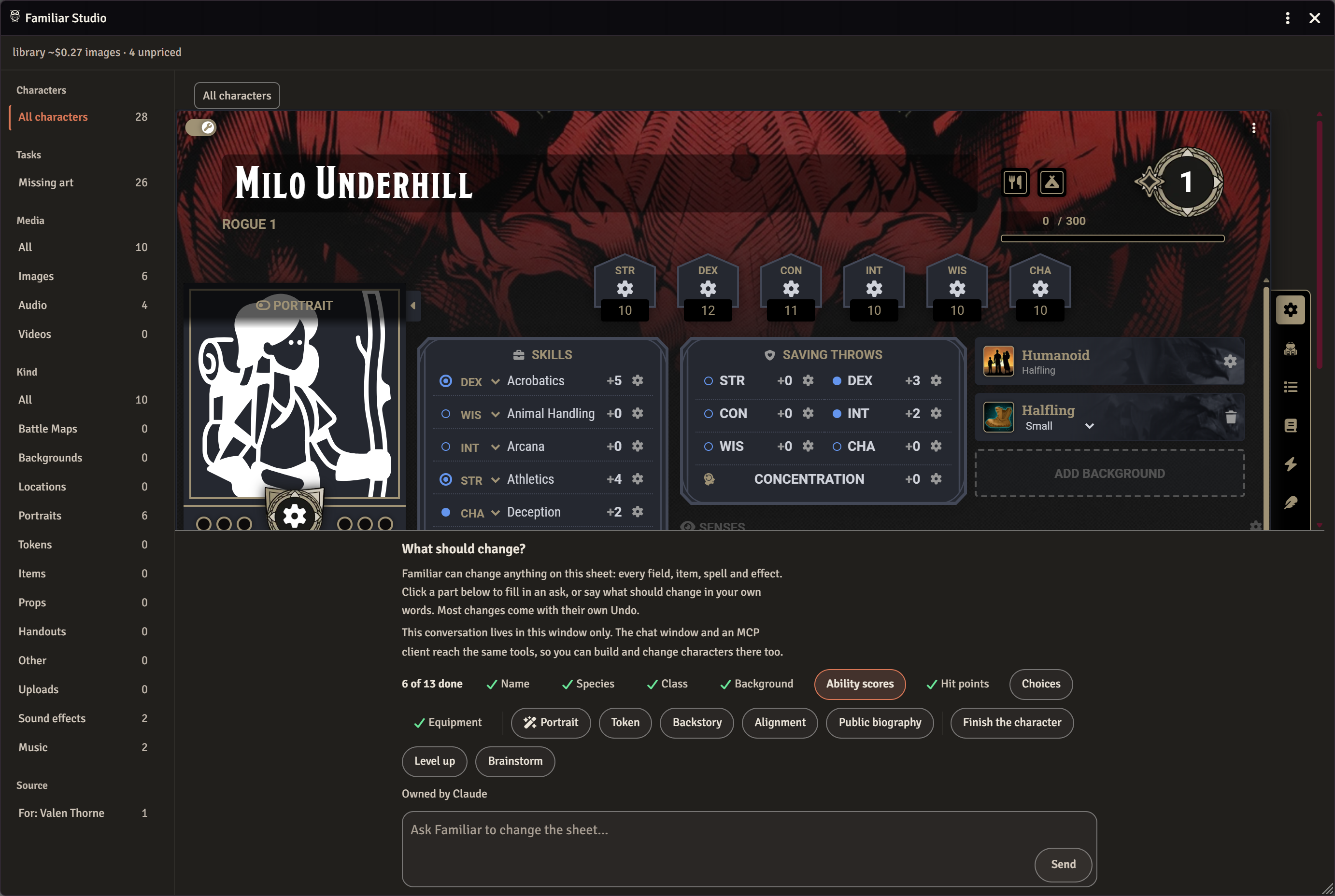
- Build a D&D 5e character from one line, "a level 5 dwarf cleric": in Familiar Studio a co-pilot bar under the real sheet plans the build, fills in the sheet, the spells and a backstory, then lays every pick out on a build card you can review and change. The starting kit, prepared spells and a level-up each come as a card you apply. Paste a stat block for a working NPC, or clone a monster from any compendium. Give, stash, and move items; on D&D 5e, pay and award coin while Familiar makes change.
- Players talk to Familiar in Foundry's own chat:
@familiaror@<NPC name>gets an answer under your approval mode,/rolledhands Familiar a roll from the sheet, and on D&D 5e/roll stealthrolls the check. Table Chat is on by default; one switch on the Chat tab turns the answers off.
Also: rollable tables, card decks, chat macros, folders, regions, Ember quests, your Obsidian vault (read-only), and /undo. The full list is at familiarvtt.com/capabilities.
Combat, refereed on D&D 5e (2024)
A rules engine checks every attack, spell, and move before it lands. Out of range, out of turn, no slot left, action already spent: the move comes back refused with the reason, the AI adapts, and Foundry's own dice roll every result.
- The turn loop: initiative, movement checked against speed and walls, multiattack, legendary actions.
- Monster reactions fire themselves: opportunity attacks, Shield, Counterspell, Sentinel, and so does Legendary Resistance. A player character's reaction stays the player's call: before it lands, Familiar asks the player, right in the chat.
- The character sheet rolls Familiar's checks, saves, attacks, damage, and spells; attack and spell cards are Foundry's own roll cards, and Dice So Nice, if you run it, throws their dice. Ask for the sheet and Familiar hands an item to it instead, targets set and the spell's area placed, and the sheet's own card and your automation take it from there.
- Weapon Mastery riders, grapple and shove as the 2024 saving throw, concentration checks at the right DC, persistent zones like Spirit Guardians, summons that join initiative, and Polymorph as a real transformation.
- Death saves, massive-damage instant death, and an undo that survives a reload.
It needs no other automation module. One world setting turns rule enforcement off, for when another module runs your combat or your table rules differently. Where a rule is not modelled yet, Familiar flags it and leaves the ruling to you.
With Auto-Pilot on, every NPC plays its own turn; a character a player owns never does, and neither do the characters you play when Familiar runs the table. Close the chat window and it keeps going, reporting each turn as a card whispered to you. You can make it ask before every turn, and it stops itself after 50 turns. Stop it yourself from the combat bar, a turn card, or Ctrl+Shift+X.
Plays what you play
Foundry lists more than 450 game systems, and the campaign you brought runs here, whichever one it was written for. Refereeing combat stays D&D 5e (2024) only, and character builds, coin, and /roll need Foundry's D&D 5e system too. On another system the tracker, the turns, and the tokens still work; the rulings stay yours. The line is drawn system by system at familiarvtt.com/systems.
Bring your own AI
Familiar runs on Foundry v13 and newer. The built-in chat runs in your browser, nothing to install, and an MCP client connects on the GM's computer, which needs Node.js 22 or newer. Live transcription, dictation, Auto-Pilot, and Table Chat's automatic answers live in the built-in chat; dictation and transcription need a secure page, https or Foundry opened via localhost. The setup wizard covers Claude Desktop and Claude Code, Codex CLI and the ChatGPT desktop app (Codex tab), Antigravity CLI and Antigravity Editor, Grok Build CLI, and Muse Code.
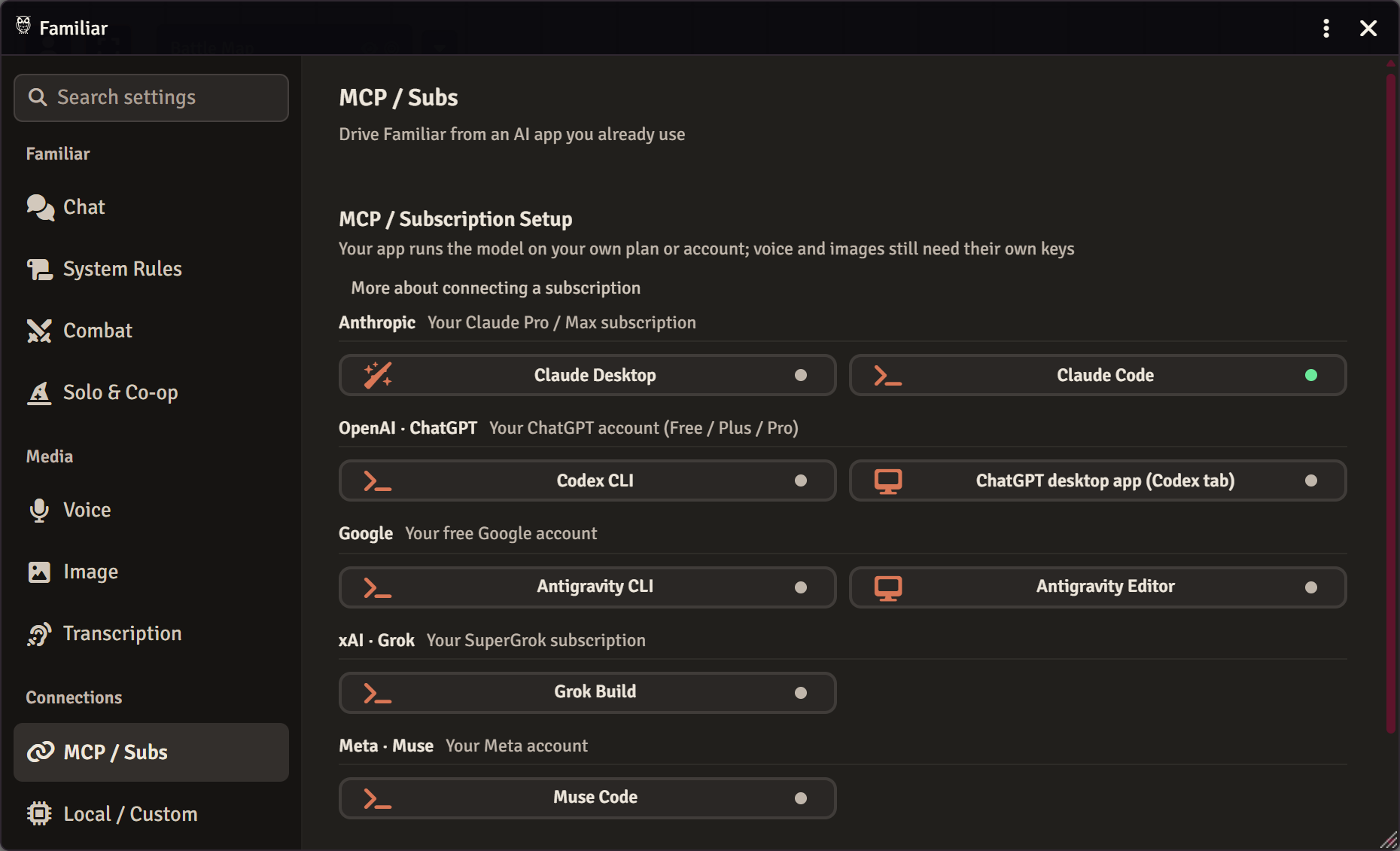
- Chat: OpenRouter (one key, 300+ models), Anthropic, OpenAI, Google, Groq, Mistral, Together AI, DeepSeek, xAI, Cohere, Perplexity, Fireworks AI, Cerebras, SambaNova, NanoGPT, or a local or custom server, with one-click presets for Ollama, LM Studio, llama.cpp, and LiteLLM, plus a Venice preset for the hosted route
- Voices: ElevenLabs, Cartesia, OpenAI TTS, OpenRouter TTS, NanoGPT TTS, or a custom TTS server
- Images: OpenAI (GPT Image), fal.ai, Leonardo AI, OpenRouter, NanoGPT, or a custom OpenAI-compatible server
- Live transcription: Gladia, Deepgram, AssemblyAI
Your key, and the text the AI reads, travel from your browser straight to the provider. Familiar never proxies, meters, or marks up a call and sends no telemetry; its one call home is the licence check.
What the AI can touch
- A world change from your chat asks under your approval mode, an MCP client under its own approvals. A player's own window writes from the player's client and reaches only what Foundry lets that player change, with one exception: from Foundry 14.352, and not on The Forge, an image or sound they make without Upload Files, which your own tab saves for them.
- The MCP link stays on localhost behind a shared secret.
- A routine edit cannot reach a document's ownership or permissions; handing a character to a player takes its own tool. The AI cannot write script code; it only runs the script macros you wrote.
- In the built-in chat a risky action waits for your confirmation unless approvals are set to Yolo; a player's risky request at the table waits for a yes: theirs or yours for their own things, yours alone for anything else or anything billed to your key.
Pricing
Free for two weeks, then $6 a month or $48 a year (four months free). Or pay $99 once, for life. The price does not move with how much you play. Cancel inside those two weeks and you are never charged; cancel later and everything Familiar made stays in your world. A typical session runs $0.50 to $3 in API tokens, billed by your provider; a subscription over MCP or a local model costs nothing on top.
Familiar is not sold through Foundry's content-key system, so there is no key to redeem here. You subscribe at familiarvtt.com/pricing, the licence key waits in your Polar customer portal (the link in your receipt email opens it) straight after checkout, and you paste it into the module settings. Players need no licence of their own; a player who opens their own Familiar window brings their own AI key. Account, invoices, and cancellation live at familiarvtt.com/account. From 3.0.0 the code is licensed under the Familiar Licence 1.1, the LICENSE file in each release; 2.26.0 and earlier stay under the PolyForm Shield License 1.0.0.
Who built this
I'm Ryan, a solo developer, dad of two young kids, married to my favourite person. My wife and I play D&D one on one, just the two of us, and solo DMing is a lot to hold at once: storyteller, every NPC, the rules engine, the sound, the atmosphere. I ran Familiar at my own table, session after session, before opening it up. Built for the DM who has more ideas than free time, and wouldn't mind playing for once.
Guides and setup live at familiarvtt.com/guides, the community answers in the Discord, and the MCP server ships on npm as familiar-vtt.
Familiar is an independent product, not affiliated with or endorsed by Wizards of the Coast. It includes material from the System Reference Document 5.2.1 ("SRD 5.2.1</a >") by Wizards of the Coast LLC, licensed under the Creative Commons Attribution 4.0 International License</a >.</em >